
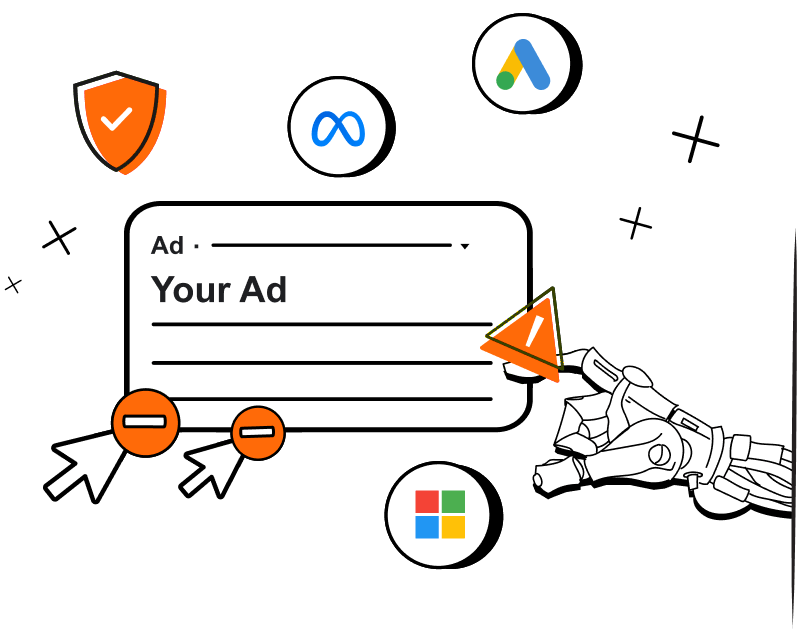

A multi-layered defense strategy for protecting lead quality and campaign data integrity.
In Brief
Stopping fake leads on Meta ads requires a comprehensive strategy that extends beyond the platform’s native tools. It involves a multi-layered defense combining proactive audience and placement controls, robust on-form validation techniques, rigorous post-submission data analysis, and active, real-time bot mitigation. A purely reactive approach of cleaning lead lists after the fact is insufficient because it fails to protect the campaign’s optimization data from being skewed by invalid signals from bot traffic.
The primary objective is not only to reduce wasted ad spend on fraudulent submissions but, more critically, to preserve the integrity of the data fed to Meta’s learning algorithms. By preventing invalid traffic from registering as conversions, advertisers ensure that optimization is driven by genuine user interest, leading to higher quality audiences and improved long-term campaign performance. This process treats lead quality as an integrated part of campaign management, not a separate janitorial task.
Implementing a Layered Defense Against Invalid Lead Submissions
The first layer of defense against fake leads is foundational campaign hygiene within Meta Ads. Fraudulent actors and bot traffic thrive on broad, loosely defined targeting and exploit low-quality placements. Advertisers must begin by scrutinizing their audience definitions, moving away from overly wide interest-based targeting toward more qualified segments like custom audiences from CRM data or well-defined lookalike audiences. Equally important is a critical review of placements. The Meta Audience Network, in particular, can be a significant source of invalid clicks and fraudulent submissions due to its vast and less transparent publisher inventory, where publisher incentives may not align with advertiser goals. Disabling it or carefully monitoring its performance is a crucial first step in reducing exposure.
The second layer involves fortifying the lead form itself against automated submissions. Standard CAPTCHAs are a basic deterrent but are easily solved by modern bots. A more effective approach includes technical measures like implementing a ‘honeypot’ field, which is invisible to humans but attractive to bots, instantly flagging any submission that fills it. Another technique is analyzing form submission speed; a form filled out in under a few seconds is almost certainly automated. Clients are often surprised that sophisticated bots can easily bypass complex multi-step qualification questions by parsing the form’s HTML, making the real defensive signal behavioral rather than content-based. This creates a tension for marketers: the need to add friction to deter bots while preserving a seamless experience for legitimate prospects.
Post-submission validation constitutes the third critical layer. Once a lead is captured, it should be subjected to immediate, automated verification before it even enters the primary CRM. This includes using API-based services to check the validity and reputation of the provided email address, flagging disposable or known fraudulent domains. It also involves analyzing the submitter’s IP address for known proxy, VPN, or data center origins, which are strong indicators of bot traffic. This systematic cleansing ensures that the sales team receives a higher quality list and prevents bad data from contaminating the CRM. A comprehensive approach to managing Meta Ads traffic quality involves connecting these post-submission signals back to platform exclusions, creating a feedback loop that strengthens targeting over time.
The final and most robust layer is the implementation of active, real-time bot mitigation. This approach moves beyond passive filtering to proactively identify and block malicious sources before they can interact with ads or submit forms. Specialized services analyze hundreds of data points per visitor in milliseconds, including device and browser fingerprints, network characteristics, and behavioral patterns like non-human mouse movements and programmatic click velocity. When a visitor is identified as a bot or part of a fraudulent network, its IP address is blocked from seeing future ads and its session is terminated. This not only stops fake leads but also prevents invalid clicks, preserving the ad budget and ensuring that campaign performance data and algorithmic optimization are based entirely on genuine human engagement.
Real-Life Example: Proactive vs. Reactive Lead Filtering
A B2B software firm using a reactive strategy had its sales team manually filter fake leads. While their reported cost-per-lead seemed low, the team wasted significant time on invalid contacts. Critically, Meta’s algorithm learned from these fraudulent conversions, optimizing the campaign to find more junk traffic. They were caught in a cycle of cleaning lists while their ad performance was undermined by polluted data signals from persistent bot traffic.
In contrast, a competitor firm used proactive bot mitigation to block fraudulent sources before form submission. Their initial cost-per-lead was slightly higher, but nearly every lead was qualified. By feeding clean conversion data to Meta’s algorithm, their campaign targeting and ROI consistently improved. One company chased a vanity metric, while the other invested in data integrity to drive real business outcomes and protect their paid media investment.
Bottom Line
Effectively stopping fake leads from Meta ads is not a single action but a continuous, systematic process. Relying solely on platform-level controls or manual post-campaign cleanup is a fundamentally flawed strategy that allows bad data to corrupt campaign optimization and waste sales resources. A successful approach requires a layered defense that starts with disciplined targeting and placement choices, incorporates technical on-form protections, validates every submission rigorously, and ultimately employs active bot mitigation to prevent fraudulent traffic from entering the funnel in the first place. This protects the ad budget and, more importantly, the data integrity that underpins all successful algorithmic advertising.