
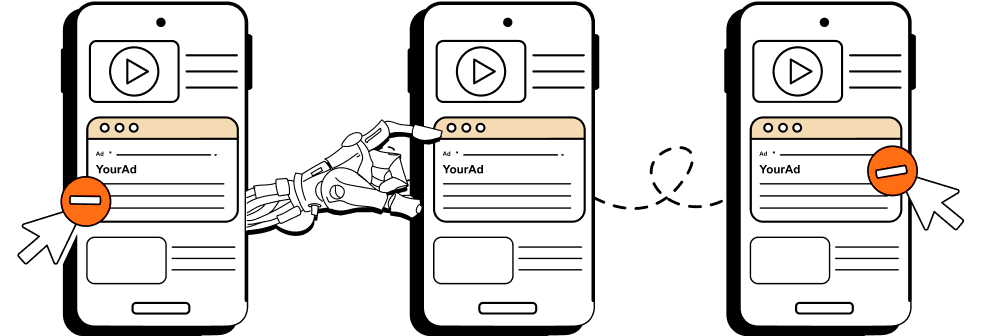

Understanding the sources of invalid traffic and fraudulent form submissions in your PPC campaigns.
In Brief
Fake leads from Google Ads campaigns are primarily generated by two sources: automated bot traffic and deliberate human fraud. These non-genuine interactions are designed to click on paid ads and submit contact forms, consuming advertising budgets without any possibility of converting into actual customers. This activity is not a random glitch but a persistent issue within the digital advertising ecosystem, driven by clear economic incentives for fraudulent actors.
The motivations behind this activity range from competitors attempting to drain your budget to fraudulent publishers seeking to generate illegitimate ad revenue from their sites. Sophisticated bots can mimic human behavior closely, making them difficult for standard platform filters to detect, while click farms employ low-wage workers to manually generate invalid clicks and form fills at scale, leading to significant financial waste and corrupted marketing data.
What to Know
The most prevalent source of fake leads is automated bot traffic. This category includes everything from simple scripts designed to scrape website content to highly sophisticated bots that can navigate websites, mimic mouse movements, and fill out complex forms. This bot traffic often originates from vast networks of compromised computers, known as botnets, or from cloud-based data centers, allowing perpetrators to generate a high volume of clicks and submissions from thousands of unique IP addresses. Their purpose is rarely targeted malice against a specific advertiser but rather large-scale fraud, often to generate revenue for dishonest publishers on the Google Display Network who are paid per click.
Beyond automated systems, a significant volume of fake leads is produced by intentional human action. The two primary vectors are competitor-driven click fraud and organized click farms. In the first scenario, a competitor manually or through hired services repeatedly clicks on your ads to deplete your daily PPC budget, effectively removing your ads from the auction for the remainder of the day. Click farms operate on a much larger scale, employing individuals in low-wage countries to manually click on ads and submit lead forms for clients aiming to disrupt competitors or for publishers committing ad fraud against the network. This human element can be difficult to distinguish from legitimate traffic without behavioral analysis.
The source of fake leads is not always a direct, malicious attack; it can also be a consequence of specific campaign settings within Google Ads itself. Campaigns opted into the Google Display Network and Search Partner Network are exposed to a wider, less-regulated inventory of websites and apps, some of which may have very low-quality traffic or be actively engaged in ad fraud. Furthermore, overly broad targeting parameters, such as targeting entire countries without nuance or using broad match keywords without a robust negative keyword list, can attract a higher percentage of irrelevant and fraudulent traffic, resulting in low-quality or completely fake leads from uninterested parties.
The immediate cost of wasted ad spend is only one part of the damage caused by fake leads. A more insidious long-term effect is the corruption of your campaign performance data. Every fake lead is incorrectly registered as a conversion, artificially inflating conversion rates and skewing cost-per-acquisition (CPA) metrics. This flawed data misguides both manual optimization efforts and Google’s automated bidding algorithms, which may learn to prioritize the sources of fraudulent traffic, believing they are high-performing segments. A dedicated fake lead prevention solution is crucial for preserving data integrity and ensuring that optimization decisions are based on genuine user engagement.
Modern fraudulent actors continuously evolve their methods to evade detection. They use residential proxies to mask their origins, making simple IP-based blocking less effective. Bots are programmed with sophisticated behavioral patterns, such as randomized time-on-site, scrolling activity, and realistic mouse movements, to appear as legitimate human visitors to standard analytics platforms. They also cycle through different user agents and clear cookies to avoid being identified as repeat visitors. This constant cat-and-mouse game means that static, rule-based prevention methods are often insufficient, requiring dynamic, behavior-based bot mitigation systems to accurately identify and block these advanced threats in real time.
Real Example
A B2B software company launched a Google Ads campaign targeting senior managers in the logistics industry with a detailed whitepaper as a lead magnet. Within the first 48 hours, they celebrated receiving over 200 form submissions. However, upon review by the sales development team, it was discovered that nearly 90% of these leads were completely unusable. The submissions used patterns of nonsensical names like “jkl jkl,” email addresses from known disposable domains, and phone numbers with incorrect formatting or repeated digits. All this traffic originated from a small cluster of IP ranges located in a country they were not actively targeting, with submissions occurring in concentrated bursts between 2 AM and 4 AM local time.
This distinct pattern of activity indicated a clear bot-driven attack rather than low-quality but legitimate human interest. The immediate impact was a wasted ad spend of several thousand dollars and dozens of hours for the sales team to manually sift through the fraudulent submissions to find any real prospects. The campaign’s conversion data was rendered useless, forcing the marketing manager to pause the entire campaign, clean the lead database, and implement an advanced bot mitigation service to filter traffic before it could trigger a conversion event. The incident highlighted that a high ad spend can make a campaign an attractive target for automated fraud, requiring protective measures.
Bottom Line
Fake leads from Google Ads are an inevitable byproduct of the programmatic advertising landscape, driven by the economic incentives available to perpetrators of automated bot activity and deliberate human fraud. Their presence is not necessarily a sign of a poorly managed campaign, but rather a persistent threat that requires a dedicated defense. Relying solely on Google’s native filters is insufficient for businesses with significant paid media budgets. Protecting your investment requires a proactive and specialized approach to bot mitigation that goes beyond basic platform-level controls and focuses on real-time threat detection and blocking, ensuring both budget preservation and the integrity of the data that fuels campaign optimization.